
 Routine maintenance
 Upgrading and renovating
 Emergency repair
 Maintenance of fire protection system
 Project inspection
 On-demand maintenance


A production factory in VSIP 1 Industrial Park, Thuan An, with about 1,800m² of metal roofing. Small leaks all over the building; in the rainy season they got worse and disrupted production and daily operation.
Leaks like these do not stop if you only patch where the water drips. Water on a metal roof runs along the ribs and the purlins, so the drip point inside is often several metres from the actual opening. To stop the leaks you have to go up, inspect the whole roof and fix it in one go. Lap joints and screw heads are the main causes.
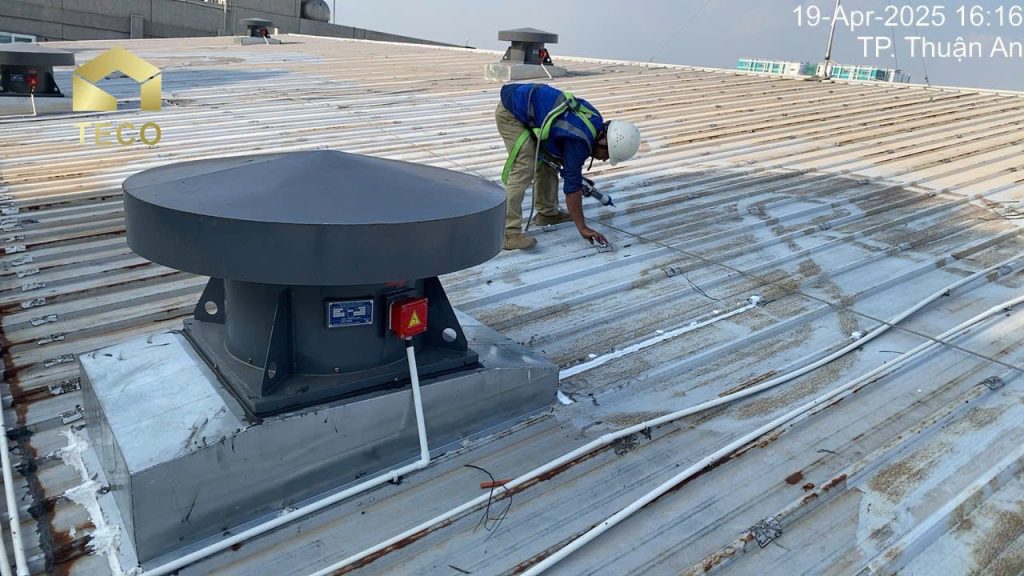
Survey
Our technicians walked the entire roof and marked every defect:
- Roofing screws rusted, many loose, rubber washers hardened or missing. This was the main source of leaks.
- Lap joints open at the rib ends, especially near the ridge capping.
- Roof exhaust fan bases with open edges, letting water run along the ribs and seep in.
- Some sheets rusted through and beyond patching; they had to be replaced.
Quantities and method were agreed with the owner before work started, so there were no surprises midway.
Safety
An old metal roof is where accidents happen: slipping, or stepping through a corroded sheet. On this job:
- Work registration and work-at-height permit with the owner and the industrial park management.
- Lifelines run along the roof. Everyone on the roof wears a hard hat and a full-body harness clipped to the lifeline at all times.
- Walk only along the purlin lines. Never step between ribs.
- Roof edges and spots hard to reach from above are handled from a boom lift, with the worker still harnessed in the basket.
- The area below is cordoned off and protected. The factory kept running as normal.
- No roof work in rain, strong wind or while the roof is still wet with morning dew.

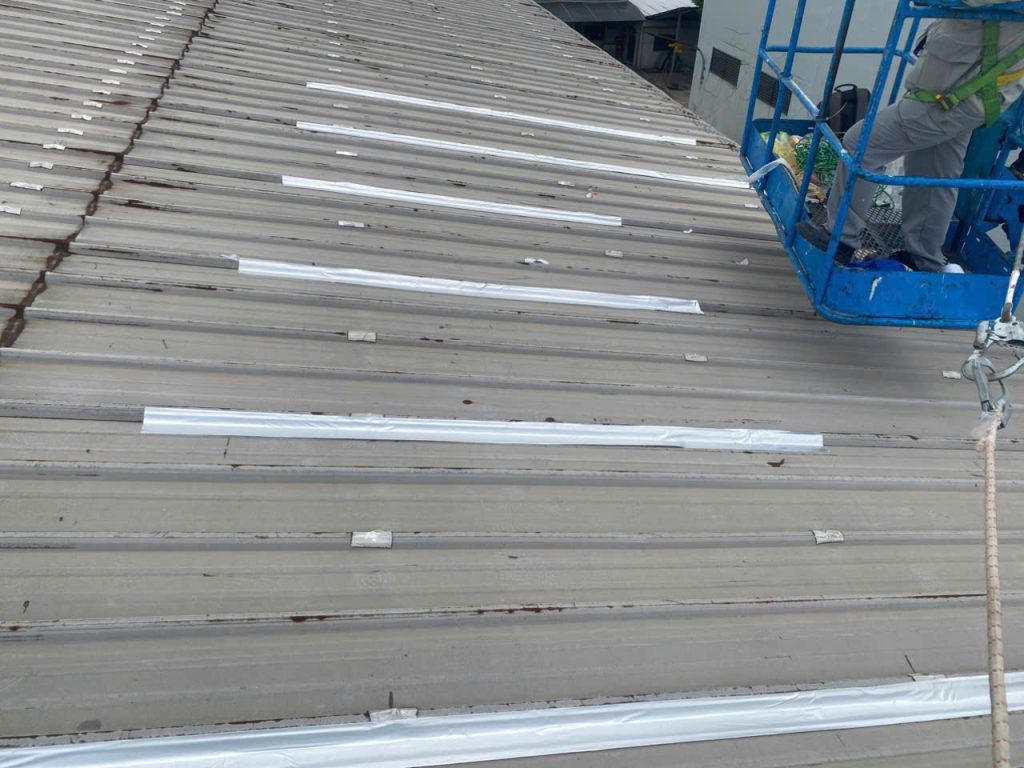
Repair work
Roofing screws
All rusted and loose screws removed and replaced with new screws and rubber washers. Enlarged old holes are sealed first and the new screw goes in next to them, never back into the old hole. Screw heads are then covered with tape caps to stop water at the base.
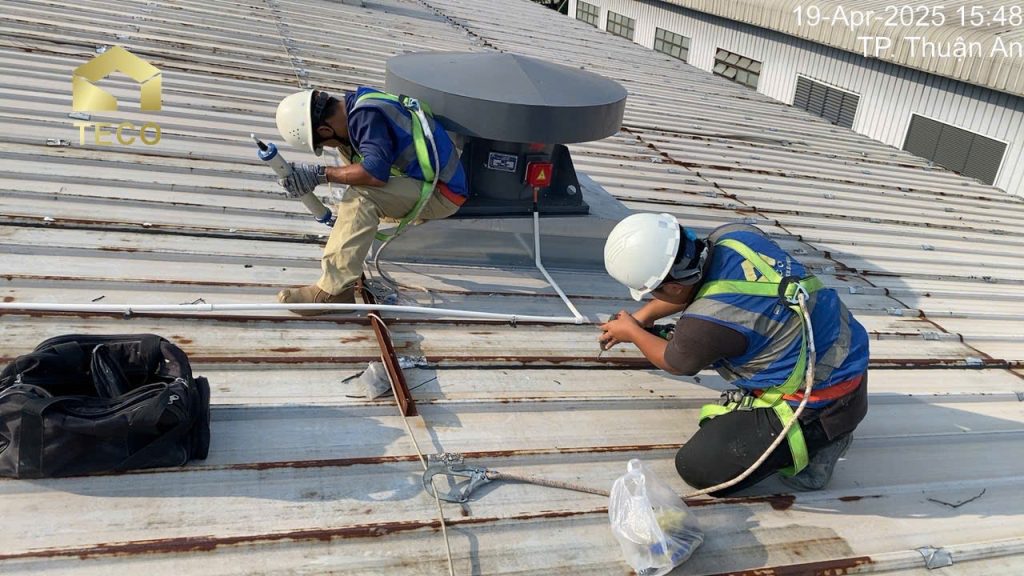
Lap joints and ridge capping
Surfaces cleaned, then waterproofing tape applied to fully cover the lap joints. Ridge capping screws and edges re-checked and any gaps sealed.
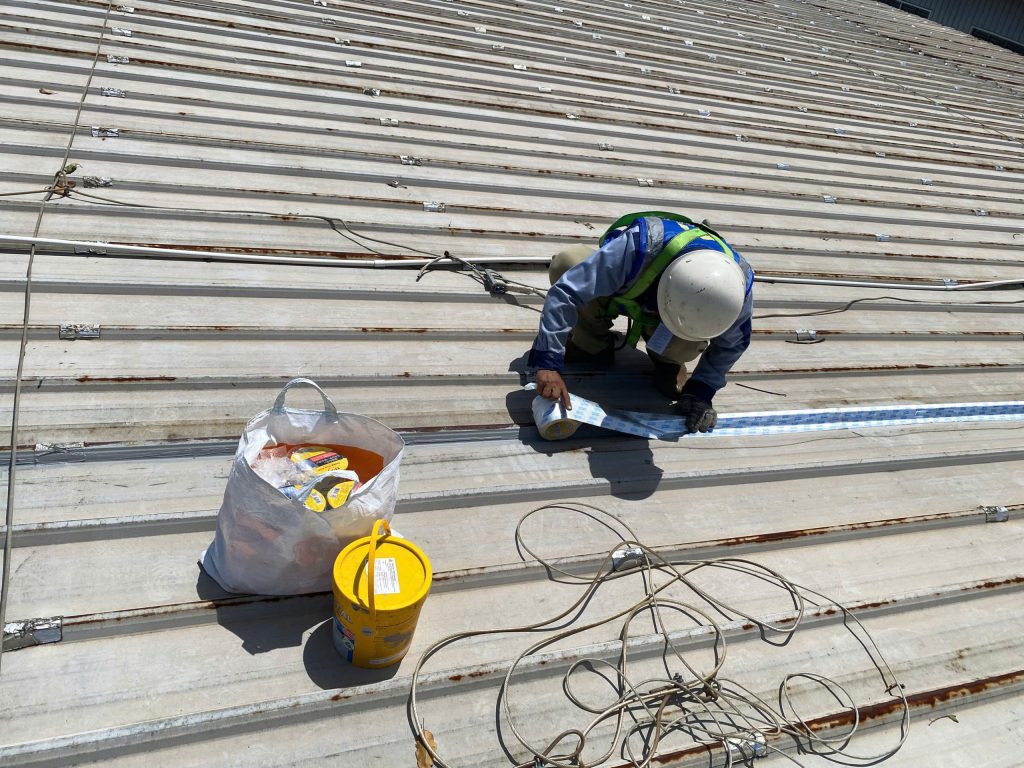
Roof exhaust fan bases
A typical leak point, as water running down the ribs collects against the fan base. The joint between base and sheet is cleaned, the full perimeter sealed, and the base fixings re-checked.
Sheet replacement
Corroded sheets cut out and replaced with sheets of the same profile, lapped in the direction of water flow, screwed and taped to the existing sheets.
Testing and handover
We do not wait for rain to find out. Once a section is done, it is water-tested with a hose while someone checks underneath for any seepage. Only when it passes do we move on. Finally, old screws and debris are cleared from the roof and the job is handed over.
Related project: Heat-reflective roof coating, 1,200m² – 2S Sai Gon Moi workshop · Office Roof Membrane Waterproofing, 350m² – Compass II, VSIP 1.
Factory roof leaking? TECO MSC will survey on site and quote based on the actual condition. See also our Emergency repair and On-demand maintenance services.
TECO MSC – the building maintenance division of TECO Architecture and Construction JSC.
Hotline: 0911 111 929